Travel
Ordering Food in Thai: Phrases for Restaurants and Street Food
Published · 7 min read

To order food in Thai, catch the staff’s attention with น้องครับ nɔ́ɔng kráp (or น้องค่ะ nɔ́ɔng kâ if you are a woman), then say ขอ kɔ̌ɔ + the dish: ขอผัดไทยหนึ่งจานครับ kɔ̌ɔ pàt-tai nʉ̀ng jaan kráp, “one pad thai, please”. Add ไม่เผ็ด mâi pèt for “not spicy” or ไม่ใส่ผักชี mâi sài pàk-chii for “no coriander”, and when you have finished, ask for the bill with เช็คบิลด้วย chék-bin dûai.
That is the whole skeleton. The rest of this article fills it in: what the staff will ask you back, how to explain a diet or an allergy, how to take food away, and the Thai names of the dishes you will actually see on menus and street carts.
How to call the waiter: พี่ or น้อง
Thais rarely say “excuse me” to call a waiter. They use a kinship word, the same ones used in the family:
| Thai | Transliteration | Use it for |
|---|---|---|
| น้องครับ / น้องค่ะ | nɔ́ɔng kráp / nɔ́ɔng kâ | staff younger than you (the usual choice) |
| พี่ครับ / พี่ค่ะ | pîi kráp / pîi kâ | staff older than you, or a stall owner |
| ป้าครับ / ป้าคะ | bpâa kráp / bpâa ká | an older woman running a stall (“auntie”) |
| ขอโทษครับ / ขอโทษค่ะ | kɔ̌ɔ-tôot kráp / kɔ̌ɔ-tôot kâ | excuse me (always polite, a bit formal) |
น้อง nɔ́ɔng means “younger sibling” and พี่ pîi “older sibling”. Using them with strangers is not overfamiliar: it is how Thai builds a warm, polite relationship. Most waiters are young, so น้อง is the default; if in doubt about someone’s age, พี่ is the flattering choice. Raise a hand slightly and say it in a normal voice, without snapping your fingers or waving.
The particle at the end is what makes it polite: ครับ kráp for male speakers, ค่ะ kâ for female speakers (คะ ká when it is a question or a call). The full story is in our article on Thai polite particles.
How to order: ขอ and เอา
Two verbs do almost all the work:
- ขอ kɔ̌ɔ, “may I have”: polite, works everywhere.
- เอา ao, “I’ll take”: more casual, normal at street stalls and when you answer a question.
| Thai | Transliteration | Meaning |
|---|---|---|
| ขอเมนูหน่อยครับ | kɔ̌ɔ mee-nuu nɔ̀i kráp | Can I have the menu, please? |
| มีเมนูภาษาอังกฤษไหม | mii mee-nuu paa-sǎa ang-grìt mǎi | Do you have an English menu? |
| แนะนำอะไรดี | nɛ́-nam à-rai dii | What do you recommend? |
| ขออันนี้ครับ | kɔ̌ɔ an-níi kráp | This one, please (pointing at the menu) |
| ขอข้าวผัดกุ้งหนึ่งจาน | kɔ̌ɔ kâao-pàt gûng nʉ̀ng jaan | One shrimp fried rice |
| เอาต้มยำกุ้งหนึ่งชาม | ao dtôm-yam-gûng nʉ̀ng chaam | One bowl of tom yum goong |
| ขอน้ำเปล่าขวดหนึ่ง | kɔ̌ɔ náam-bplàao kùat nʉ̀ng | A bottle of water |
| ขอข้าวเปล่าสองจาน | kɔ̌ɔ kâao-bplàao sɔ̌ɔng jaan | Two plates of plain rice |
When you give a quantity, the order is dish + number + classifier: จาน jaan (plate) for dishes, ชาม chaam (bowl) for soups and noodle soups, แก้ว gɛ̂ɛo (glass) for drinks, ขวด kùat (bottle). The logic is explained in our guide to Thai classifiers. If you forget the classifier, pointing and saying ขออันนี้ kɔ̌ɔ an-níi will still get you fed.
Ordering a meat with a dish follows the same pattern: dish + meat. ข้าวผัด kâao-pàt is fried rice, ข้าวผัดหมู kâao-pàt mǔu pork fried rice, ข้าวผัดไก่ kâao-pàt gài chicken fried rice. The main options are หมู mǔu (pork), ไก่ gài (chicken), เนื้อ nʉ́a (beef), กุ้ง gûng (shrimp), ปลาหมึก bplaa-mʉ̀k (squid) and ทะเล tá-lee (seafood).
What the staff will ask you
Ordering is a conversation, and the questions come back fast. These are the ones to recognize:
| Thai | Transliteration | Meaning |
|---|---|---|
| รับอะไรดีครับ / คะ | ráp à-rai dii kráp / ká | What would you like? |
| กินเผ็ดได้ไหม | gin pèt dâai mǎi | Can you eat spicy food? |
| เอาไข่ดาวไหม | ao kài-daao mǎi | Do you want a fried egg (on top)? |
| น้ำหรือแห้ง | náam rʉ̌ʉ hɛ̂ɛng | With soup or dry? (noodles) |
| กินที่นี่หรือกลับบ้าน | gin tîi-nîi rʉ̌ʉ glàp bâan | Eat here or take away? |
The answer is often just the key word: เผ็ดได้ pèt dâai (“spicy is fine”), เอา ao (“yes, I’ll take it”), ไม่เอา mâi ao (“no thanks”), กินที่นี่ gin tîi-nîi (“here”).
How spicy? เผ็ด and its degrees
เผ็ด pèt (low tone) means spicy. Be careful not to confuse it with เป็ด bpèt, “duck”: same tone, but the first consonant is aspirated in “spicy” and unaspirated in “duck”.
| Thai | Transliteration | Meaning |
|---|---|---|
| ไม่เผ็ด | mâi pèt | not spicy |
| เผ็ดนิดหน่อย | pèt nít-nɔ̀i | a little spicy |
| เผ็ดน้อย | pèt nɔ́ɔi | less spicy |
| เผ็ดมาก | pèt mâak | very spicy |
| ไม่ใส่พริก | mâi sài prík | no chili |
| เผ็ดไหม | pèt mǎi | Is it spicy? |
“Not spicy” is relative. Chili is in the curry paste, the dressing and the dipping sauce, so ไม่เผ็ด usually means “no extra chili”, not “zero heat”. Hugo learns this the hard way with his first pad thai in the story At the restaurant, and asks for “a little spicy” in Som tam, with mixed results.
In noodle shops the heat is often added by you. Every table has a set of condiments, เครื่องปรุง krʉ̂ang-bprung: chili flakes (พริกป่น prík-bpòn), sugar (น้ำตาล náam-dtaan), fish sauce (น้ำปลา náam-bplaa) and sliced chilies in vinegar (พริกน้ำส้ม prík-náam-sôm). Taste first, then season: that is how Thais eat noodles.
No coriander, vegetarian, allergies
The key pattern is ไม่ใส่… mâi sài…, “don’t put…”. It works for any ingredient:
| Thai | Transliteration | Meaning |
|---|---|---|
| ไม่ใส่ผักชี | mâi sài pàk-chii | no coriander |
| ไม่ใส่ผงชูรส | mâi sài pǒng-chuu-rót | no MSG |
| ไม่ใส่น้ำตาล | mâi sài náam-dtaan | no sugar |
| ไม่ใส่น้ำแข็ง | mâi sài náam-kɛ̌ng | no ice |
| ไม่ใส่เนื้อสัตว์ | mâi sài nʉ́a-sàt | no meat |
Hugo’s very polite request for no coriander is the whole plot of the story No coriander. Add ครับ or ค่ะ and a smile, and the cook will usually be happy to oblige.
Vegetarian and vegan food in Thai
Thai has two words for meat-free food, and they are not the same:
- มังสวิรัติ mang-sà-wí-rát: vegetarian, no meat or fish. Say ผมกินมังสวิรัติ pǒm gin mang-sà-wí-rát (“I eat vegetarian”).
- เจ jee: the Chinese-Thai Buddhist diet, กินเจ gin jee. No meat, no animal products and no strong-smelling vegetables like garlic and onion. Stalls serving it hang yellow flags with the character เจ in red, especially during the Vegetarian Festival in the autumn.
The trap for vegetarians is the sauces: fish sauce น้ำปลา náam-bplaa and oyster sauce น้ำมันหอย náam-man-hɔ̌i are in many dishes. Ask explicitly: ไม่ใส่น้ำปลา mâi sài náam-bplaa. At a เจ stall, everything is already plant-based.
Allergies: แพ้
แพ้ pɛ́ɛ means “to be allergic to” (it also means “to lose” a game). The structure is subject + แพ้ + food:
ผมแพ้ถั่วลิสง pǒm pɛ́ɛ tùa-lí-sǒng: I am allergic to peanuts.
ฉันแพ้กุ้ง chǎn pɛ́ɛ gûng: I am allergic to shrimp (female speaker).
แพ้อาหารทะเล pɛ́ɛ aa-hǎan-tá-lee: allergic to seafood.
For a serious allergy, carry the sentence written in Thai as well: noise, accents and busy kitchens make a spoken request easy to miss.
Take away: ใส่ถุง and กลับบ้าน
Thais take food home constantly, in small plastic bags tied with a rubber band. To ask for it:
- ใส่ถุง sài tǔng: “put it in a bag”, the street-food phrase.
- กลับบ้าน glàp bâan: “to go home”, the usual answer to กินที่นี่หรือกลับบ้าน.
- ห่อกลับบ้าน hɔ̀ɔ glàp bâan: “wrap it to take home”, also for leftovers in a restaurant.
So a full order at a stall can be: ขอผัดกะเพราหมูสับไข่ดาว กลับบ้านครับ kɔ̌ɔ pàt-gà-prao mǔu-sàp kài-daao, glàp bâan kráp, “basil pork with a fried egg, to take away”.
Asking for the bill
| Thai | Transliteration | Where |
|---|---|---|
| เช็คบิลด้วยครับ / ค่ะ | chék-bin dûai kráp / kâ | restaurants, cafés, bars |
| เก็บเงินด้วย | gèp ngən dûai | street stalls, simple shops |
| เก็บตังค์ด้วย | gèp dtang dûai | same, more colloquial |
| ทั้งหมดเท่าไหร่ | táng-mòt tâo-rài | How much is it altogether? |
| แยกจ่าย | yɛ̂ɛk jàai | Separate bills |
ด้วย dûai at the end turns the request into a polite “please”. In restaurants you can also catch the waiter’s eye and draw a little scribble in the air: everyone understands. Prices will come in baht, so it helps to know your Thai numbers before the bill arrives.
Tipping is not expected at street stalls. In sit-down restaurants, leaving the small change is common and appreciated, and some places already add a service charge.
Saying it was delicious
| Thai | Transliteration | Meaning |
|---|---|---|
| อร่อยมาก | à-ròi mâak | very delicious |
| อร่อยจัง | à-ròi jang | so tasty! (warm, spontaneous) |
| อิ่มแล้ว | ìm lɛ́ɛo | I’m full |
| ขอบคุณครับ / ค่ะ | kɔ̀ɔp-kun kráp / kâ | thank you |
อร่อยมาก is the one sentence every cook in Thailand loves to hear from a foreigner. Say it with a smile on your way out.
15 famous Thai dishes and how to say them
Rice and noodles
| Thai | Transliteration | What it is |
|---|---|---|
| ผัดไทย | pàt-tai | stir-fried rice noodles with egg, tofu, peanuts |
| ผัดซีอิ๊ว | pàt-sii-íu | wide noodles stir-fried in soy sauce |
| ก๋วยเตี๋ยว | gǔai-dtǐao | noodle soup (the generic word) |
| ข้าวผัด | kâao-pàt | fried rice |
| ผัดกะเพรา | pàt-gà-prao | stir-fry with holy basil, usually with minced pork (หมูสับ mǔu-sàp) |
| ข้าวมันไก่ | kâao-man-gài | Hainanese chicken rice |
| ข้าวซอย | kâao-sɔɔi | Northern curry noodle soup (Chiang Mai) |
Soups and curries
| Thai | Transliteration | What it is |
|---|---|---|
| ต้มยำกุ้ง | dtôm-yam-gûng | hot and sour shrimp soup |
| ต้มข่าไก่ | dtôm-kàa-gài | chicken soup with coconut milk and galangal |
| แกงเขียวหวาน | gɛɛng-kǐao-wǎan | green curry |
| พะแนง | pá-nɛɛng | panang curry, thick, rich and fairly mild |
Salads and grills
| Thai | Transliteration | What it is |
|---|---|---|
| ส้มตำ | sôm-dtam | green papaya salad |
| ลาบ | lâap | spicy minced meat salad with lime and herbs |
| ไก่ย่าง | gài-yâang | grilled chicken, eaten with sticky rice |
Dessert
| Thai | Transliteration | What it is |
|---|---|---|
| ข้าวเหนียวมะม่วง | kâao-nǐao-má-mûang | mango sticky rice |
Two spelling notes for the curious. กะเพรา (holy basil) is often misspelled กระเพรา on menus, which is close to กระเพาะ grà-pɔ́, “stomach”. And names describe the dish literally: แกงเขียวหวาน is “curry-green-sweet”, ข้าวเหนียวมะม่วง “rice-sticky-mango”. Once you know a few dozen words, menus start to read themselves.
One more habit to know: Thais eat with a spoon and a fork, ช้อน chɔ́ɔn and ส้อม sɔ̂ɔm. The fork pushes food onto the spoon, and the spoon goes to the mouth. Chopsticks, ตะเกียบ dtà-gìap, are for noodle soups.
How to practise
- Order in Thai every time, even badly. Start with ขอ + dish + ครับ/ค่ะ, then add one new element per meal: the spice level, then “take away”, then the bill.
- Read menus aloud. Most Thai menus have pictures and the Thai name. Matching them is free reading practice.
- Rehearse the scenes before you live them. Three Kru May stories, At the restaurant, No coriander and Som tam, cover ordering, spice and special requests, with every sentence recorded at natural and slow speed. Next step: the phrases for shopping at a Thai market.
Questions and answers
How do you say “not spicy” in Thai?
Say ไม่เผ็ด (mâi pèt), and add ครับ (kráp) if you are a man or ค่ะ (kâ) if you are a woman. For a little heat, ask for เผ็ดนิดหน่อย (pèt nít-nɔ̀i). Even “not spicy” food can be a bit hot, because chili is part of many sauces.
How do you ask for the bill in Thai?
In a restaurant, say เช็คบิลด้วยครับ (chék-bin dûai kráp) or เช็คบิลด้วยค่ะ (chék-bin dûai kâ). At a street stall, say เก็บเงินด้วย (gèp ngən dûai), “please collect the money”.
How do you say “no coriander” in Thai?
ไม่ใส่ผักชี (mâi sài pàk-chii), literally “don’t put coriander”. The same pattern works for anything: ไม่ใส่พริก (mâi sài prík) is “no chili”, ไม่ใส่น้ำแข็ง (mâi sài náam-kɛ̌ng) “no ice”.
Practice with these stories
Read the words from this article in context, in illustrated stories with audio.
At the restaurant
ที่ร้านอาหาร
Hugo’s first pad thai. He tries “not spicy” — and discovers it’s relative.
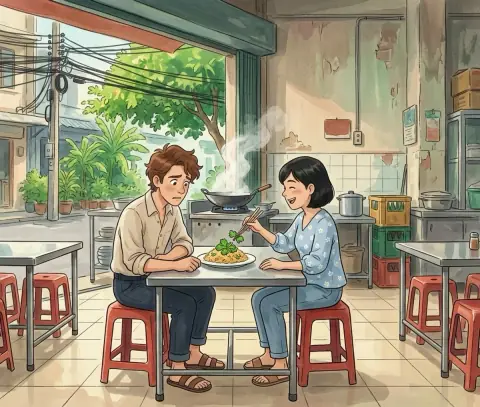
No coriander
ไม่ใส่ผักชี
Hugo orders fried rice and asks, very politely, for no coriander. The fried rice has opinions.

Som tam
ส้มตำ
Mali’s friend Nok introduces Hugo to green papaya salad. He asks for “a little spicy”. Nok does not.
Keep reading

Thai Market Phrases: Prices, Bargaining and Shopping for Clothes
Shop at a Thai market: ask how much, kilos and pieces, bargain politely (and know when not to), sizes and colors, trying on, paying by QR code or cash.

Getting Around in Thai: Taxis, Tuk-Tuks, BTS, Boats and Directions
The Thai you need to get around: taxi and tuk-tuk phrases, motorbike taxis, BTS and MRT, river boats, left, right, straight on and the places to ask for.

Thai Phrases for Travelers: 50 Essentials, from Hello to Help
50 essential Thai phrases for travelers, by situation: greetings, hotel, food, shopping, transport and emergencies, with transliteration and tips.