Travel
Thai Phrases for Travelers: 50 Essentials, from Hello to Help
Published · 6 min read

The essential Thai phrases for travelers fit on one page: สวัสดี sà-wàt-dii (hello), ขอบคุณ kɔ̀ɔp-kun (thank you), ขอโทษ kɔ̌ɔ-tôot (sorry), เท่าไหร่ tâo-rài (how much?), ไม่เข้าใจ mâi kâo-jai (I don’t understand) and …อยู่ที่ไหน yùu tîi-nǎi (where is…?). End each one with ครับ kráp if you are a man or ค่ะ kâ if you are a woman, and you already sound polite.
Below are 50 phrases grouped by situation, each with Thai script, transliteration and meaning. They are short on purpose: in Thai, a two- or three-word phrase with the right tone and a polite particle is perfectly natural. Each section links to a more detailed article when the topic deserves one.
Before you start: polite particles and pronunciation
Thai has no single word for “please”. Politeness comes mostly from a small word at the end of the sentence:
- ครับ kráp: said by men, in every kind of sentence.
- ค่ะ kâ: said by women at the end of a statement.
- คะ ká: said by women at the end of a question.
The tables below leave the particle out to keep them readable. Add it every time you speak to a stranger, a driver, a vendor or anyone older than you. The full explanation is in the guide to Thai polite particles.
Five pronunciation tips will make you far easier to understand:
- Follow the tone marks in the transliteration. No accent is a mid tone, à low, â falling, á high, ǎ rising. ใกล้ glâi (near) and ไกล glai (far) differ only by their tone. The Thai tones guide has audio for all five.
- Hold the long vowels. A doubled vowel (aa, ii, uu) is long: bàat (baht) is longer than bàt (card).
- bp and dt are not b, p, d or t. ป bp and ต dt are unaspirated, like the p in spin and the t in stop. ไป bpai (go) is not “bye” or “pie”.
- Do not release final consonants. The t of bàat or the k of dèk is stopped, not exploded: your mouth closes and nothing comes out.
- No h after k, t, p. The transliteration used here writes kɔ̀ɔp-kun and pûut, but those sounds are aspirated, with a puff of air, as at the start of English cat and pot.
Greetings and politeness
| Thai | Transliteration | Meaning |
|---|---|---|
| สวัสดี | sà-wàt-dii | hello; goodbye |
| ขอบคุณ | kɔ̀ɔp-kun | thank you |
| ไม่เป็นไร | mâi-bpen-rai | you’re welcome; never mind |
| ขอโทษ | kɔ̌ɔ-tôot | sorry; excuse me |
| สบายดีไหม | sà-baai-dii mǎi | how are you? |
| ยินดีที่ได้รู้จัก | yin-dii-tîi-dâai-rúu-jàk | nice to meet you |
| แล้วเจอกัน | lɛ́ɛo jəə gan | see you |
สวัสดี sà-wàt-dii works for hello and goodbye, at any time of day. People often accompany it with a wai, palms together; if someone wais you, a wai back or a smile and a slight nod is the right answer. ขอโทษ kɔ̌ɔ-tôot is also what you say to get past someone in a crowded BTS carriage or to call a waiter. More basic words are in the list of basic Thai words.
Understanding each other
| Thai | Transliteration | Meaning |
|---|---|---|
| ไม่เข้าใจ | mâi kâo-jai | I don’t understand |
| พูดช้า ๆ หน่อยได้ไหม | pûut cháa-cháa nɔ̀i dâai mǎi | could you speak a bit slower? |
| พูดอีกครั้งได้ไหม | pûut ìik kráng dâai mǎi | could you say it again? |
| พูดภาษาอังกฤษได้ไหม | pûut paa-sǎa ang-grìt dâai mǎi | do you speak English? |
| พูดภาษาไทยได้นิดหน่อย | pûut paa-sǎa-tai dâai nít-nɔ̀i | I speak a little Thai |
| อันนี้ภาษาไทยเรียกว่าอะไร | an-níi paa-sǎa-tai rîak wâa à-rai | what is this called in Thai? |
…ได้ไหม dâai mǎi at the end of a sentence means “can you…?” or “is it possible…?”. It is the most useful structure for a traveler: add it to any verb and you have a polite request. The sign ๆ repeats the word before it, so ช้า ๆ is read cháa-cháa.
At the hotel
| Thai | Transliteration | Meaning |
|---|---|---|
| จองห้องไว้แล้ว | jɔɔng hɔ̂ng wái lɛ́ɛo | I have a reservation |
| มีห้องว่างไหม | mii hɔ̂ng wâang mǎi | do you have a room available? |
| คืนละเท่าไหร่ | kʉʉn lá tâo-rài | how much per night? |
| เช็กเอาต์กี่โมง | chék-áo gìi moong | what time is check-out? |
| รหัสไวไฟคืออะไร | rá-hàt wai-fai kʉʉ à-rai | what is the wifi password? |
| แอร์ไม่เย็น | ɛɛ mâi yen | the air conditioning isn’t cold |
คืนละ kʉʉn lá means “per night”: ละ lá is the same “per” that you hear at the market in กิโลละ… (“… a kilo”). In the story “The island”, Nok books a hotel on an island, which is a good way to hear jɔɔng and roong-rɛɛm in context.
Eating and drinking
| Thai | Transliteration | Meaning |
|---|---|---|
| ขอเมนูหน่อย | kɔ̌ɔ mee-nuu nɔ̀i | the menu, please |
| เอาอันนี้ | ao an-níi | I’ll have this one |
| ไม่เผ็ด | mâi pèt | not spicy |
| ไม่ใส่ผักชี | mâi sài pàk-chii | no coriander |
| ไม่กินเนื้อสัตว์ | mâi gin nʉ́a-sàt | I don’t eat meat |
| แพ้ถั่ว | pɛ́ɛ tùa | I’m allergic to peanuts |
| น้ำเปล่า | náam-bplàao | plain water |
| เช็กบิลด้วย | chék-bin dûai | the bill, please |
ขอ kɔ̌ɔ (“may I have”) + the thing + หน่อย nɔ̀i is the standard way to ask for something: ขอน้ำเปล่าหน่อย kɔ̌ɔ náam-bplàao nɔ̀i, “some water, please”. If you have an allergy, say it clearly and early; แพ้ pɛ́ɛ + the food works for any allergen. Dishes, spice levels and street food are covered in detail in ordering food in Thai.
Shopping and paying
| Thai | Transliteration | Meaning |
|---|---|---|
| เท่าไหร่ | tâo-rài | how much? |
| แพงไป | pɛɛng bpai | too expensive |
| ลดได้ไหม | lót dâai mǎi | can you give a discount? |
| ลองได้ไหม | lɔɔng dâai mǎi | can I try it on? |
| รับบัตรไหม | ráp bàt mǎi | do you take cards? |
| ไม่เอา ขอบคุณ | mâi ao, kɔ̀ɔp-kun | no thanks |
Bargaining is normal at markets and with some tuk-tuks, much less so in shops with marked prices, in malls or at a 7-Eleven. Keep it friendly: a smile and ลดได้ไหม lót dâai mǎi go further than an argument. To understand the answer, you need the numbers, which you can learn in an evening with our guide to Thai numbers; market vocabulary is in Thai market phrases.
Getting around
| Thai | Transliteration | Meaning |
|---|---|---|
| ไป… ไหม | bpai… mǎi | do you go to…? |
| …อยู่ที่ไหน | …yùu tîi-nǎi | where is…? |
| ไกลไหม | glai mǎi | is it far? |
| เปิดมิเตอร์ด้วย | bpə̀ət mí-dtə̂ə dûai | please use the meter |
| จอดตรงนี้ | jɔ̀ɔt dtrong-níi | stop here |
| ขอตั๋วไปเชียงใหม่หนึ่งใบ | kɔ̌ɔ dtǔa bpai chiang-mài nʉ̀ng bai | one ticket to Chiang Mai, please |
| รถไฟออกกี่โมง | rót-fai ɔ̀ɔk gìi moong | what time does the train leave? |
Tickets are counted with the classifier ใบ bai: dtǔa sɔ̌ɔng bai is “two tickets”. Taxis, tuk-tuks, motorbike taxis, the BTS and boats each have their own little vocabulary, explained in getting around in Thai. If you plan to travel by train, the stories “Chiang Mai” (twelve hours north by train) and “The night train” (back to Bangkok in a sleeper carriage) use exactly this vocabulary.
Emergencies and health
| Thai | Transliteration | Meaning |
|---|---|---|
| ช่วยด้วย | chûai dûai | help! |
| ไม่สบาย | mâi sà-baai | I’m not well |
| ปวดหัว | bpùat hǔa | I have a headache |
| ปวดท้อง | bpùat tɔ́ɔng | I have a stomach ache |
| เป็นไข้ | bpen kâi | I have a fever |
| แพ้ยา | pɛ́ɛ yaa | I’m allergic to a medicine |
| เรียกหมอให้หน่อย | rîak mɔ̌ɔ hâi nɔ̀i | please call a doctor |
| โรงพยาบาลอยู่ที่ไหน | roong-pá-yaa-baan yùu tîi-nǎi | where is the hospital? |
| ร้านขายยาอยู่ที่ไหน | ráan-kǎai-yaa yùu tîi-nǎi | where is the pharmacy? |
| โทรศัพท์หาย | too-rá-sàp hǎai | I’ve lost my phone |
Note the difference between ไม่สบาย mâi sà-baai (“not well”, the polite way to say you are ill) and ปวด bpùat + a body part, which says exactly where it hurts. Pharmacists in tourist areas often speak some English, and pharmacies are a common first stop for minor problems. The useful numbers in Thailand are 1155 (tourist police, with English-speaking operators), 191 (police) and 1669 (medical emergencies).
Phrases that work everywhere
If you remember only four structures, make it these. They turn the words above into dozens of sentences:
ขอ… หน่อย kɔ̌ɔ… nɔ̀i: may I have…, please
…ได้ไหม …dâai mǎi: can you… / is it possible to…?
…อยู่ที่ไหน …yùu tîi-nǎi: where is…?
ไม่… mâi…: not… (ไม่เผ็ด, ไม่เอา, ไม่เข้าใจ)
Common mistakes travelers make
- Choosing the particle by the listener. ครับ kráp and ค่ะ kâ depend on who is speaking, not on who you are talking to. A man says kráp to a woman, and a woman says kâ to a man.
- Worrying about the r. In everyday speech, many Thais pronounce ครับ closer to káp, and the r of many words is softened to an l or dropped. You will be understood either way; what matters more is the high tone.
- Raising your voice. When you are not understood, speaking louder rarely helps and can come across as anger, which is badly perceived in Thailand. Repeat more slowly, point, or show the word written in Thai.
- Translating “no” too directly. A flat ไม่ mâi on its own sounds abrupt. To turn something down, ไม่เป็นไร mâi-bpen-rai or ไม่เอา ขอบคุณ mâi ao, kɔ̀ɔp-kun with a smile is how Thais do it. Why this phrase does so much work is explained in our article on Thai cultural expressions.
How to practise before you go
Travel phrases stick when you have heard them in a situation, not just read them in a list. Say each phrase out loud with its particle, copying the melody from a recording rather than reading the transliteration word by word. Kru May follows Hugo through exactly these situations in 90 illustrated stories, from his first สวัสดี to the train ride to Chiang Mai, with every sentence recorded at natural and slow speed and every word tappable for its meaning and tone.
Questions and answers
What are the most important Thai phrases for a trip?
สวัสดี sà-wàt-dii (hello), ขอบคุณ kɔ̀ɔp-kun (thank you), ขอโทษ kɔ̌ɔ-tôot (sorry, excuse me), เท่าไหร่ tâo-rài (how much?), ไม่เข้าใจ mâi kâo-jai (I don’t understand) and …อยู่ที่ไหน yùu tîi-nǎi (where is …?). Add ครับ kráp (men) or ค่ะ kâ (women) at the end.
How do you say “help!” in Thai?
ช่วยด้วย chûai dûai! In Thailand, the tourist police number is 1155, the police 191 and medical emergencies 1669.
Do I need to learn the Thai tones to be understood?
For short travel phrases, context helps a lot, but tones do change meaning: ใกล้ glâi is “near”, ไกล glai is “far”. Copying the melody of each phrase from audio is the fastest way; the guide to the Thai tones explains the system.
Practice with these stories
Read the words from this article in context, in illustrated stories with audio.
The island
ไปเกาะ
Nok books a hotel on an island. Plane, boat, blue water, and a sunset that nobody wants to leave.

The night train
รถไฟกลางคืน
Back to Bangkok in a sleeper carriage. The beds are small, the train is loud, and the stars are the best part.

Chiang Mai
ไปเชียงใหม่
Twelve hours by train to the mountains of the north. Cool air, temples everywhere, and Mali’s verdict: the most beautiful place there is.
Keep reading
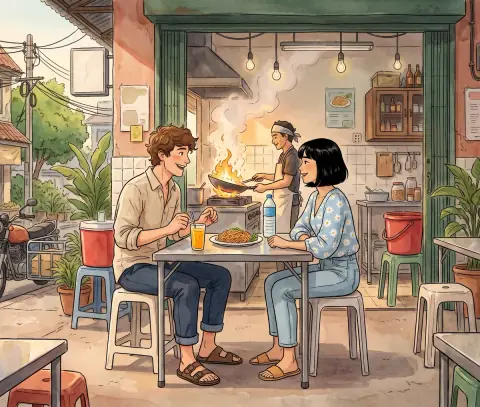
Ordering Food in Thai: Phrases for Restaurants and Street Food
Order food in Thai: call the waiter, ask for not spicy or no coriander, say you are vegetarian, get the bill, plus 15 famous dishes with their Thai names.
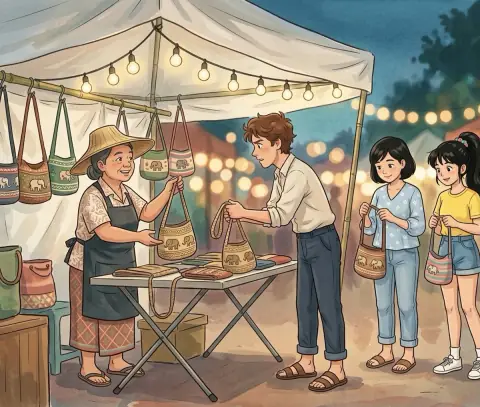
Thai Market Phrases: Prices, Bargaining and Shopping for Clothes
Shop at a Thai market: ask how much, kilos and pieces, bargain politely (and know when not to), sizes and colors, trying on, paying by QR code or cash.

Getting Around in Thai: Taxis, Tuk-Tuks, BTS, Boats and Directions
The Thai you need to get around: taxi and tuk-tuk phrases, motorbike taxis, BTS and MRT, river boats, left, right, straight on and the places to ask for.