Vocabulary
Thai Family Words: Mother, Father, Siblings, Grandparents and More
Published · 7 min read
The core Thai family words are พ่อ pɔ̂ɔ (father), แม่ mɛ̂ɛ (mother), พี่ pîi (older brother or sister), น้อง nɔ́ɔng (younger brother or sister) and ลูก lûuk (child, son or daughter). What makes the Thai system different from English is that it cares first about age and side of the family, and only second about gender: there is no single word for “brother”, but there are four words for “grandparent”. The same words are also used every day with people who are not family at all.
The word for “family” itself is ครอบครัว krɔ̂ɔp-krua. In Thailand it often means more than parents and children: grandparents, aunts and cousins may live in the same house or on the same soi, and a Sunday meal can mean a dozen people around one table.
Why Thai family words are about age
Thai society is built on seniority. Who is older decides who greets first with a wai, who serves the food, who pays the bill and, above all, how people speak to each other. Family words carry that information in every sentence: saying พี่ instead of “my brother” reminds everyone who is the elder.
This is also why Thais often ask your age early in a conversation. อายุเท่าไหร่ aa-yú tâo-rài (“how old are you?”) is not rude curiosity: the answer tells them whether to call you พี่ or น้อง, and which polite words to use. A year’s difference is enough. If you are asked, answer simply, and expect to be called by your new “rank” from then on.
Parents and children
| Thai | Transliteration | Meaning |
|---|---|---|
| พ่อ | pɔ̂ɔ | father, dad |
| แม่ | mɛ̂ɛ | mother, mum |
| พ่อแม่ | pɔ̂ɔ-mɛ̂ɛ | parents |
| คุณพ่อ | kun-pɔ̂ɔ | father (respectful) |
| คุณแม่ | kun-mɛ̂ɛ | mother (respectful) |
| ลูก | lûuk | child (son or daughter) |
| ลูกชาย | lûuk-chaai | son |
| ลูกสาว | lûuk-sǎao | daughter |
| ลูกคนโต | lûuk-kon-dtoo | eldest child |
| ลูกคนเล็ก | lûuk-kon-lék | youngest child |
พ่อ and แม่ are what children call their parents. คุณพ่อ and คุณแม่ sound more respectful: use them when you talk about someone else’s parents, or in a formal context. ลูก means “child” only in the sense of “son or daughter”; a child in general is เด็ก dèk. Parents also call their children ลูก directly, as a term of affection: ลูก, กินข้าว lûuk, gin kâao is “come and eat, sweetheart”.
Brothers and sisters: older or younger first
In Thai you cannot say “my brother” without saying whether he is older or younger than you. The first word gives the age; ชาย chaai (male) or สาว sǎao (female) adds the gender, and is often left out.
| Thai | Transliteration | Meaning |
|---|---|---|
| พี่ | pîi | older sibling (brother or sister) |
| น้อง | nɔ́ɔng | younger sibling (brother or sister) |
| พี่ชาย | pîi-chaai | older brother |
| พี่สาว | pîi-sǎao | older sister |
| น้องชาย | nɔ́ɔng-chaai | younger brother |
| น้องสาว | nɔ́ɔng-sǎao | younger sister |
| พี่น้อง | pîi-nɔ́ɔng | siblings, brothers and sisters |
The story “The little brother” opens with exactly this word:
นี่คือน้องชายมะลิ ชื่อต้น nîi kʉʉ nɔ́ɔng-chaai má-lí, chʉ̂ʉ dtôn — This is Mali’s little brother. His name is Ton.
Watch the tone on พี่ pîi: it is a falling tone. Said with a rising tone, ผี pǐi, it means “ghost”. Our guide to Thai tones explains how to hear and produce the difference.
Grandparents: four different words
English has two grandfathers and two grandmothers; Thai gives each one a different word, depending on whether they are your father’s or your mother’s parents.
| Thai | Transliteration | Meaning | Side |
|---|---|---|---|
| ปู่ | bpùu | grandfather | father’s father |
| ย่า | yâa | grandmother | father’s mother |
| ตา | dtaa | grandfather | mother’s father |
| ยาย | yaai | grandmother | mother’s mother |
| ทวด | tûat | great-grandparent | either side |
A simple way to remember it: ปู่ and ย่า go together (father’s side), ตา and ยาย go together (mother’s side). ตา also means “eye”, and ย่า yâa (falling tone) must not be confused with ยา yaa (mid tone), “medicine”. Add คุณ for extra respect: คุณยาย kun-yaai, คุณตา kun-dtaa.
This is why the grandmother in the Kru May stories is simply called Yai: ยาย is not her name but her role, Mali’s grandmother on her mother’s side, and the whole soi calls her that. In Sunday at Yai’s, the first line says:
วันนี้ทุกคนไปกินข้าวที่บ้านยาย wan-níi túk-kon bpai gin kâao tîi bâan yaai — Today everyone goes to eat at Yai’s house.
Uncles and aunts: older or younger than your parent
This is the part learners find hardest, but the logic is clear once you see it. Thai first asks: is this person older or younger than your parent?
- Older than your father or mother: ลุง lung (uncle) or ป้า bpâa (aunt). The side does not matter.
- Younger than your parent: น้า náa on your mother’s side, อา aa on your father’s side. Here gender does not matter: น้า and อา can be a man or a woman.
| Thai | Transliteration | Who it is |
|---|---|---|
| ลุง | lung | older brother of your father or mother |
| ป้า | bpâa | older sister of your father or mother |
| น้า | náa | younger brother or sister of your mother |
| อา | aa | younger brother or sister of your father |
So your mother’s younger sister is น้า, and so is your mother’s younger brother; to be precise, Thais say น้าสาว náa-sǎao or น้าชาย náa-chaai. Your father’s older brother and your mother’s older brother are both ลุง. In everyday use, the husband or wife of a ลุง or ป้า is also called ลุง or ป้า.
Grandchildren, nieces, nephews and cousins
| Thai | Transliteration | Meaning |
|---|---|---|
| หลาน | lǎan | grandchild; niece, nephew |
| หลานชาย | lǎan-chaai | grandson; nephew |
| หลานสาว | lǎan-sǎao | granddaughter; niece |
| ลูกพี่ลูกน้อง | lûuk-pîi-lûuk-nɔ́ɔng | cousin |
| ญาติ | yâat | relative(s) |
หลาน covers both grandchildren and nephews or nieces; context tells which. The word for cousin literally means “child of an older sibling, child of a younger sibling”. Traditionally, the hierarchy carries over: the child of your parent’s older sibling is your พี่, even if they are younger than you.
Husband, wife and partner
| Thai | Transliteration | Meaning | Register |
|---|---|---|---|
| สามี | sǎa-mii | husband | neutral, polite |
| ภรรยา | pan-rá-yaa | wife | neutral, polite |
| แฟน | fɛɛn | boyfriend, girlfriend; partner, spouse | everyday |
| ผัว | pǔa | husband | very colloquial |
| เมีย | mia | wife | very colloquial |
| แต่งงาน | dtɛ̀ng-ngaan | to marry, married | neutral |
| โสด | sòot | single | neutral |
สามี and ภรรยา are the correct, polite words; the unusual spelling of ภรรยา is read pan-rá-yaa. In conversation, many Thais simply say แฟน fɛɛn (from the English “fan”) for a partner, married or not. ผัว and เมีย are old, everyday words that you will hear at markets and in films, but they are blunt and can sound crude in polite company: understand them, and use สามี, ภรรยา or แฟน yourself.
In-laws depend on whose parents they are. A man calls his wife’s parents พ่อตา pɔ̂ɔ-dtaa and แม่ยาย mɛ̂ɛ-yaai; a woman’s husband’s parents are พ่อสามี pɔ̂ɔ-sǎa-mii and แม่สามี mɛ̂ɛ-sǎa-mii.
Family words for strangers: พี่, น้อง, ป้า, ลุง
This is the most useful section for a visitor. Thais address people they don’t know with family words, chosen by apparent age. It sounds friendly and polite, much warmer than คุณ.
| Who | What to call them | Transliteration |
|---|---|---|
| Waiter or shop assistant your age or a bit older | พี่ | pîi |
| Young waiter, 7-Eleven cashier, student | น้อง | nɔ́ɔng |
| Woman selling at a market stall, around your parents’ age | ป้า | bpâa |
| Older man, taxi or tuk-tuk driver | ลุง | lung |
| Someone older than you but younger than your parents | น้า | náa |
| Elderly woman or man | ยาย, ตา (or คุณยาย, คุณตา) | yaai, dtaa |
Add ครับ or ค่ะ and you have a natural way to get someone’s attention:
พี่ครับ เก็บเงินด้วยครับ pîi kráp, gèp ngən dûai kráp — Excuse me, the bill please.
น้องคะ ขอน้ำหนึ่งแก้วค่ะ nɔ́ɔng ká, kɔ̌ɔ náam nʉ̀ng gɛ̂ɛo kâ — Excuse me, may I have a glass of water?
ป้าคะ อันนี้เท่าไหร่คะ bpâa ká, an-níi tâo-rài ká — Excuse me, how much is this one?
When you hesitate, guess younger. Calling a woman ป้า when she sees herself as a พี่ can sting; พี่ is always flattering. For more of these phrases at a stall, see our guide to Thai market phrases.
The same words also replace “I” and “you” within the family and beyond, which is explained in our article on Thai pronouns.
Talking about your family
These are the questions you will be asked in your first conversations, often within minutes of meeting someone:
| Thai | Transliteration | Meaning |
|---|---|---|
| มีพี่น้องกี่คน | mii pîi-nɔ́ɔng gìi kon | How many brothers and sisters do you have? |
| ผมมีพี่สาวหนึ่งคน | pǒm mii pîi-sǎao nʉ̀ng kon | I have one older sister. |
| ฉันเป็นลูกคนเดียว | chǎn bpen lûuk kon diao | I’m an only child. |
| แต่งงานหรือยัง | dtɛ̀ng-ngaan rʉ̌ʉ yang | Are you married (yet)? |
| มีแฟนหรือยัง | mii fɛɛn rʉ̌ʉ yang | Do you have a partner (yet)? |
Notice คน kon, the classifier for people, after every number: พี่สาวหนึ่งคน, “older sister one person”. And don’t be surprised by personal questions such as แต่งงานหรือยัง: in Thailand they are ordinary small talk, not intrusive.
Common mistakes with Thai family words
- Saying “brother” without the age. พี่ชาย and น้องชาย are not interchangeable. If you do not know whether someone is older or younger, ask before you introduce them.
- Mixing up the grandmothers. ยาย is your mother’s mother, ย่า your father’s. Calling your Thai partner’s paternal grandmother ยาย is a small but noticeable slip.
- Forgetting that น้า and อา depend on the side. A younger sibling of the mother is น้า, a younger sibling of the father is อา, whatever their gender.
- Using ลูก for any child. ลูก is always someone’s son or daughter. For a child in the street, say เด็ก.
- Counting without คน. “Two older sisters” is พี่สาวสองคน pîi-sǎao sɔ̌ɔng kon, never สองพี่สาว.
- Calling a stranger ป้า too early. If a woman could plausibly be a พี่, call her พี่.
How to practise Thai family words
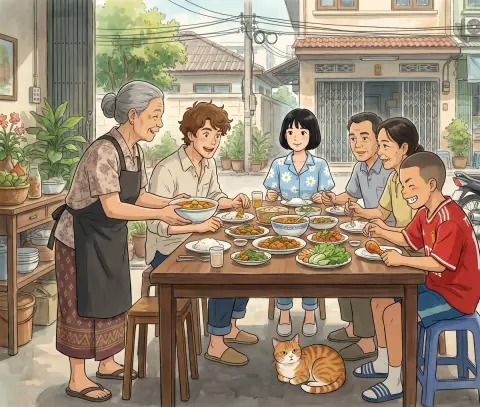
Family words are much easier to remember when they belong to real people. In the Kru May stories, Hugo is invited next door in Mali’s family and meets everyone at once, then gets a seat at the table when the whole family eats at Yai’s on Sunday. Later, in A gift for Yai, the soi celebrates her seventieth birthday. Each word has audio at natural and slow speed, so you can hear the difference between ย่า and ยาย before you say it to someone’s grandmother.
Questions and answers
How do you say mother and father in Thai?
Mother is แม่ (mɛ̂ɛ) and father is พ่อ (pɔ̂ɔ). To sound more respectful, for example when talking about someone else’s parents, add คุณ: คุณแม่ (kun-mɛ̂ɛ), คุณพ่อ (kun-pɔ̂ɔ).
What is the difference between ยาย and ย่า?
ยาย (yaai) is your mother’s mother and ย่า (yâa) your father’s mother. Grandfathers follow the same split: ตา (dtaa) on the mother’s side, ปู่ (bpùu) on the father’s side.
How do you say brother and sister in Thai?
Thai has no word for “brother” without saying whether he is older or younger. An older brother is พี่ชาย (pîi-chaai), a younger brother น้องชาย (nɔ́ɔng-chaai); an older sister is พี่สาว (pîi-sǎao), a younger sister น้องสาว (nɔ́ɔng-sǎao).
Why do Thai people call strangers พี่?
Thais address each other by relative age, as if everyone were family. พี่ (pîi, “older sibling”) is polite and warm for someone your age or older; น้อง (nɔ́ɔng) is for someone younger, and ป้า or ลุง for older women and men.
Practice with these stories
Read the words from this article in context, in illustrated stories with audio.
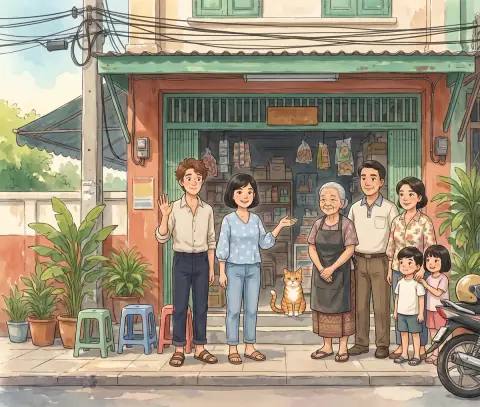
Mali’s family
ครอบครัวมะลิ
Hugo is invited next door and meets everyone at once. There are a lot of them.
Sunday at Yai’s
วันอาทิตย์ที่บ้านยาย
The whole family eats at Yai’s on Sunday. Hugo gets a seat at the table.
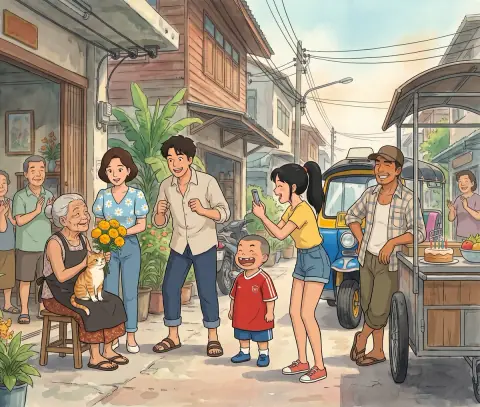
A gift for Yai
ของขวัญให้ยาย
Yai turns seventy tomorrow. Yellow flowers, a new shirt, and the whole soi at her door.
Keep reading
Basic Thai Words: Hello, Thank You and the First Phrases to Learn
The basic Thai words to learn first: hello with the wai, thank you, sorry, never mind, yes and no, please, how are you, goodbye and “I don’t understand”.

Thai Numbers: How to Count from 1 to 1,000,000
Learn Thai numbers from 0 to a million: the ten digits, the two irregular numbers, how to build any number, Thai numerals and how to read prices.
How to Say I Love You in Thai (and Other Words of Affection)
How to say I love you in Thai: ผมรักคุณ, ฉันรักคุณ, รักนะ, plus I miss you, pet names, compliments and the ways Thais really show affection.